
























-
 Written by
Bren Gray
Written by
Bren Gray -
02 Mar 20268 min. read
Weather can greatly affect the F1 race results, influencing driver performance, team tactics, and betting odds. Sudden rain, extreme heat, or unexpected changes in track conditions can all affect the outcome. Knowing how the weather impacts racing is important for successful betting.
Table of Contents
- Key Takeaways
- The Effect of Rain on Race Results
- Tire Strategy Adjustments in F1
- F1 Drivers to Watch in Challenging Weather Conditions
- How Temperature Affects F1 Car Performance?
- Visibility & Safety in Formula 1 Races Based on Weather
- Unexpected F1 Race Outcomes in History
- Formula 1 Race Strategies for Different Weather Conditions
- Weather Affect on F1 Teams, Drivers, and F1 Race Results
- FAQs on Weather Impact in F1 Races Results
Key Takeaways
- Weather impacts race results, making them unpredictable.
- Tire strategy is crucial in wet and dry conditions.
- Sudden weather changes create betting opportunities as odds shift.
- Hamilton, Verstappen, and Norris excel in tough weather conditions.
- Teams adjust their strategies based on weather forecasts to improve performance.
The Effect of Rain on Race Results
Rainy conditions in Formula 1 add more unpredictability, often significantly affecting the F1 race results. Factors like reduced grip, limited visibility from spray, and the challenges of switching tires (from dry to wet) play a key role. Drivers need to adjust their driving style, while car setups must be modified to achieve optimal aerodynamic performance and downforce.
Performance of F1 Drivers in Wet Conditions
Teams such as Mercedes and Red Bull perform well in wet conditions, thanks to excellent tire management and adaptable strategies, which is reflected in their higher wet race win rates (~40%). In contrast, Ferrari faces more challenges, particularly with tire warm-up and setup issues, resulting in a lower success rate in wet races (~20%).
| Team | Wet Race Wins | Approx. Wet Win % | Wet Weather Performance |
|---|---|---|---|
| Mercedes | 8 wins out of ~18 wet races | ~44% | Strong in adapting to wet conditions, excellent tire management, flexible strategies, and skilled drivers. |
| Red Bull | 7 wins out of ~18 wet races | ~39% | Aggressive tire strategies and good car balance, performing well in wet weather. |
| McLaren | ~4 wins out of ~20 wet races | ~20% | Inconsistent performance; often makes mistakes with tire timing and struggles with tire management in the rain. |
| Ferrari | ~5 wins out of ~25 wet races | ~20% | Challenges with tire warm-up and setup, leading to poor grip and instability. Frequently makes strategic mistakes and maintains a slower pace. |
Tire Strategy Adjustments in F1
In F1, choosing the right tires for dry, wet, or mixed conditions is essential, especially with unpredictable weather. This decision directly affects betting outcomes.
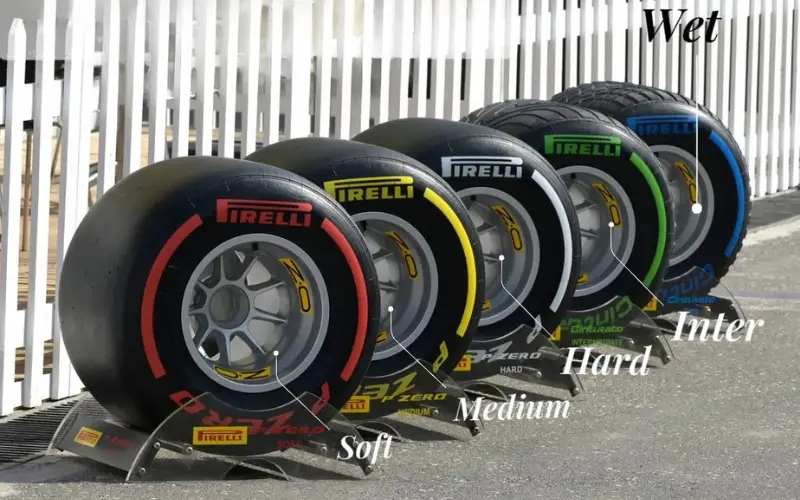
Wet (Blue) Tires
Full-wet tires, with their deep grooves, provide the best grip on wet tracks. However, they wear out quickly and lose performance on drying surfaces, requiring teams to use them strategically.
For betting, heavy rain can drastically shift race outcomes. A notable example is the 2022 Monaco Grand Prix, where wet conditions changed the race entirely. Sergio Pérez managed the situation expertly and won, while Ferrari’s poor pit timing cost Leclerc the race.
In these situations, betting on drivers who remain composed and quick in the rain can be rewarding, as unpredictable weather often leads to surprising results.
Intermediate (Green) Tires
Intermediate tires are designed for mixed conditions, providing grip in light rain or dampness while resisting wear on drying tracks. Teams use them strategically, carefully timing their switch to avoid making the change too early or too late.
Betting on intermediates can be risky. Sudden rain showers can quickly make tire choices irrelevant, affecting F1 race results. Observing how teams react to changing weather conditions can uncover valuable betting opportunities.
Dry (Orange) Tires
Grooveless dry tires offer grip on dry tracks and are classified as soft, medium, or hard, balancing speed and durability. This classification influences pit stop strategies.
Dry races tend to be more predictable for bettors, but tire wear and pit stop timing still play a key role. Your betting decisions will improve if you understand which teams excel at managing their tires.
F1 Drivers to Watch in Challenging Weather Conditions
When the weather becomes unpredictable, certain drivers shine in tough conditions. We’ve highlighted those who excel in these situations and how it impacts their chances in betting.
| Driver | Complicated Weather Performance | Odds Shifts |
|---|---|---|
| Lewis Hamilton | Exceptional physical fitness and mental focus under heat and fatigue; great tire and strategy management in changing conditions. | Shorten |
| Max Verstappen | Aggressive driving style; quick to adapt car balance and tire wear in variable conditions. | Shorten |
| Lando Norris | Strong consistency and calmness in tricky conditions; good at managing tire temperatures in cold or damp weather. | Improve |
| Fernando Alonso | Great skills and tactical intelligence; excels in maintaining car control and pace in extreme heat and cold. | Shorten |
| George Russell | High endurance and focus in physically demanding races; skilled at maximizing performance when grip is limited. | Improve |
| Lance Stroll | Known for solid performances in slippery or variable conditions; good at managing tire wear and race strategy. | Improve |
Note: shortened odds indicate a higher likelihood of a driver winning, while improved odds offer a larger payout if they succeed.
How Temperature Affects F1 Car Performance?
Track temperature plays a crucial role in Formula 1 car performance, influencing tire efficiency and race strategies. High temperatures (over 45°C) can cause tires to overheat, reducing grip, increasing wear, and slowing lap times. On the other hand, low temperatures (below 25°C) result in harder tires with poor grip, affecting acceleration and cornering.
As a result, teams must carefully choose tire compounds and adjust car setups based on the predicted track conditions. For instance, teams with strong tire management, like Mercedes or Red Bull, often perform better in hotter conditions, while teams like Ferrari thrive in milder temperatures.
When placing bets, you can use track temperature data to predict team performance and adjust your strategy accordingly, based on how each team performs under different conditions, ultimately influencing the F1 race results.
Visibility & Safety in Formula 1 Races Based on Weather
In Formula 1, reduced visibility due to adverse weather is a major safety concern. Heavy rain leads to blinding spray, while fog or glare can obscure the track and other cars, making it extremely challenging for drivers to see and increasing the risk of collisions at high speeds.
In response to these dangerous conditions, race officials may intervene. A Safety Car is deployed in marginal weather to slow the pace and reduce spray. If the conditions deteriorate further and become unsafe, a Red Flag is issued, halting the race and sending cars back to the pits, with driver safety being the top priority.
Unexpected F1 Race Outcomes in History
Weather has played a pivotal role in creating unexpected outcomes in F1 race history, often surprising bettors as race results are completely altered by changing conditions.
One notable example is the 2011 Canadian Grand Prix, where Jenson Button started from the back of the grid to win in heavy rain, defying expectations that Sebastian Vettel would win. Another memorable event was the 2021 Belgian Grand Prix, where heavy rain brought out the red flag and resulted in a half-point win for Max Verstappen, despite there being almost no actual racing, leaving many bettors frustrated.
| Driver | Year | Event | Reasons |
|---|---|---|---|
| Emerson Fittipaldi (McLaren) | 1975 | British Grand Prix | Sudden rain caused crashes and race stoppages; Fittipaldi won after restarts. |
| Lewis Hamilton (McLaren) | 2007 | Japanese Grand Prix | Won in very heavy rain and fog; the race started behind the safety car. |
| Jenson Button (McLaren) | 2009 | Malaysian Grand Prix | Torrential rain stopped the race early; Button led at the stoppage. |
| Jenson Button (McLaren) | 2011 | Canadian Grand Prix | Rain delays and restarts let Button recover from last to win. |
| Max Verstappen (Red Bull) | 2016 | Brazilian Grand Prix | Heavy rain helped Verstappen climb from 14th to 3rd place. |
| Max Verstappen (Red Bull) | 2021 | Belgian Grand Prix | Heavy rain caused delays; the race ran 3 laps behind the safety car with half points awarded. |
| Max Verstappen (Red Bull) | 2023 | Sao Paulo Grand Prix | Mastered heavy rain and changing weather to win from a low grid. |
Formula 1 Race Strategies for Different Weather Conditions
Weather plays a crucial role in Formula 1, shaping teams’ strategies to achieve the best race outcomes. In varying weather conditions, teams must adjust tire choices, pit-stop strategies, and driving styles to optimize performance.
Understanding these strategies can enhance your enjoyment of the sport and help you make more informed betting choices, ultimately giving you a better insight into how the weather can impact the F1 race results.
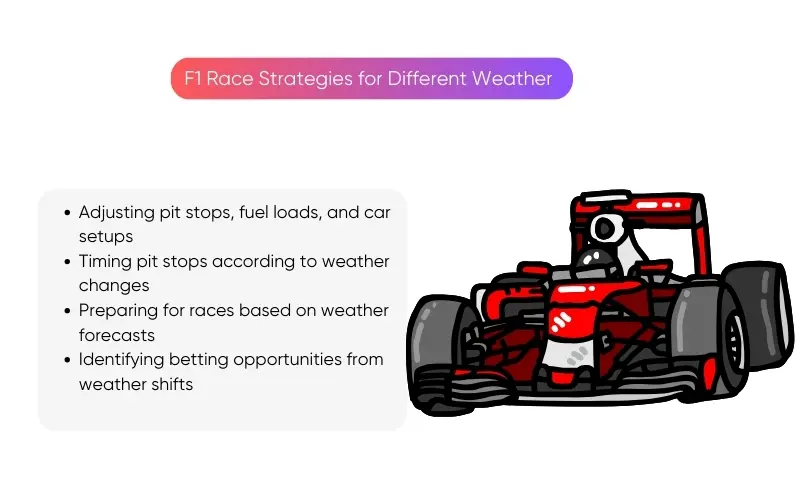
Adapting Pit Stops, Fuel Loads, and Car Setups
Teams closely monitor weather forecasts and adjust their strategies accordingly. In rainy conditions, they use lighter fuel loads to allow for more flexible pit stops, enabling drivers to react to sudden changes in the weather. Car setups are modified for increased grip and stability, with a focus on higher downforce.
In extremely hot conditions, tire preservation and cooling become top priorities. Teams adjust fuel loads and strategies to minimize pit stops, opting for harder tire compounds that perform better under high track temperatures.
Timing Pit Stops with Weather Changes
Timing pit stops correctly can be crucial in determining race outcomes. Teams rely on weather radar and real-time forecasts to decide the perfect moment to change tires as conditions evolve. When rain is forecast, they prepare to switch from slick to wet or intermediate tires, often taking advantage of safety-car periods to minimize the loss of track positions.
Race Preparation Based on Weather Forecasts
Teams start preparing for a race weekend well in advance by analyzing weather forecasts. They carefully plan the ideal tire choices and aerodynamic setups based on the expected weather conditions.
If rain is expected, cars are prepped to switch to higher downforce settings for better grip and handling. In hot conditions, the focus shifts to optimizing tire longevity and ensuring efficient cooling systems.
Betting Opportunities with Changing Weather
Weather changes not only affect team strategies but also present betting opportunities. Unexpected shifts in weather can cause odds to fluctuate rapidly, providing keen bettors with better chances in F1 race betting.
Experienced bettors track live weather updates and understand which teams, like Mercedes and Red Bull, perform well in changing conditions. This insight helps them make more informed bets, especially with the best betting bookmakers who offer odds that reflect these dynamics. Additionally, drivers known for their wet-weather prowess, such as Max Verstappen or Lewis Hamilton, become popular betting choices.
Weather Affect on F1 Teams, Drivers, and F1 Race Results
Weather is a major factor in Formula 1, influencing tire selection, car setups, and pit strategies. Rain, heat, or sudden temperature changes can dramatically affect performance and F1 race results. Teams like Red Bull and Mercedes tend to adapt more effectively, while others may struggle in wet or extreme conditions.
For bettors, this creates opportunities to identify value bets, particularly when odds haven’t yet reflected weather changes. Monitoring weather, tire strategies, and driver performance in challenging conditions can improve F1 race bets.
FAQs on Weather Impact in F1 Races Results
Recommended Articles
Bren Gray
Sports Betting Expert
Betting news